
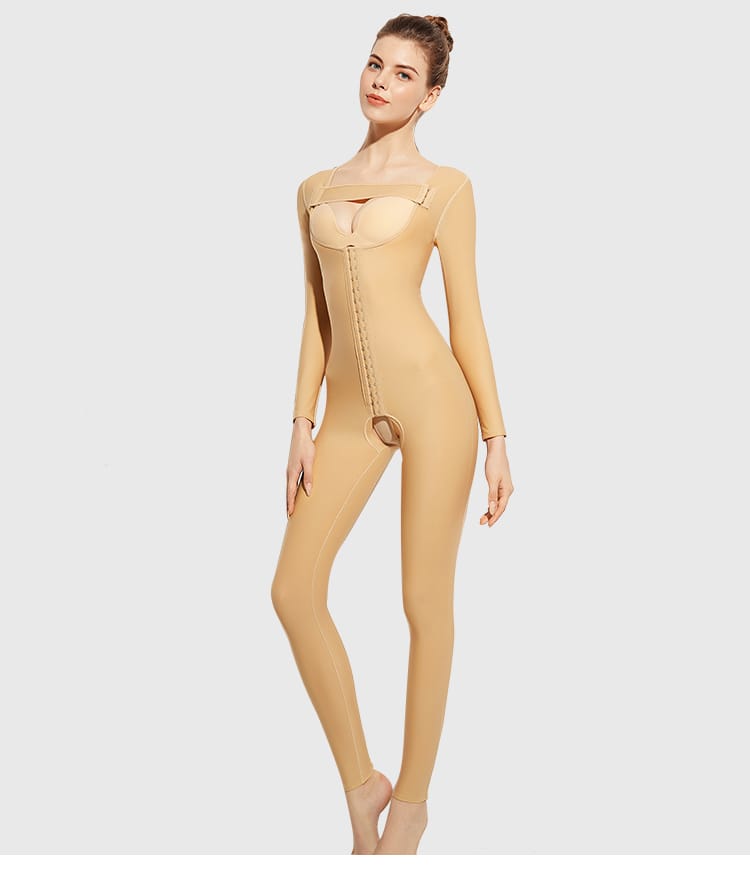
Liposuction removes fat. What happens next how well your skin retracts, how smooth your contour becomes, how quickly you recover is significantly influenced by the compression garment you wear afterwards.
This is the complete guide to post-liposuction compression garments: what they do, what to look for, and how to wear them correctly.
Quick answer: follow the recovery plan written for your procedure
A compression garment may be included after liposuction to provide support and help manage postoperative swelling, but the appropriate coverage, firmness and wearing schedule are not universal. Follow the instructions supplied by your surgeon or qualified care team, and ask before changing stages, garment length or compression level.
Why compression may be included in a post-liposuction plan
After liposuction, a surgeon may recommend an elastic bandage or compression garment to support the treated area and help manage swelling while the body heals.
The benefit, garment type and duration can vary according to the procedure, treated area, surgical technique and individual recovery. Compression should therefore be described as one possible part of a postoperative plan—not as a universal guarantee against swelling, bruising, seroma, pain or contour irregularity.
The post-liposuction recovery timeline at a glance
Recovery is not linear, but most patients follow a predictable arc. Knowing what each phase looks like helps you choose the right garment and avoid premature transitions that compromise your final result.
- Days 1-3: Heaviest swelling and drainage. Stage 1 garment worn continuously. Movement limited to short walks. Drains may still be in place depending on procedure volume.
- Days 4-14: Swelling begins shifting downward (gravity-dependent edema). Bruising peaks around day 5-7 then fades. Stage 1 garment continues, swapped only for showering and washing.
- Weeks 3-4: Transition window. Most surgeons clear patients to move to Stage 2 garments at the 3-week post-op visit. Skin starts retracting visibly.
- Weeks 5-8: Stage 2 worn 12-16 hours daily. Final contour begins emerging as residual swelling resolves.
- Months 3-6: Light everyday shapewear optional but recommended for larger-volume cases. Final result typically settles at 6 months.
Stage 1 and Stage 2: useful shopping terms, not universal medical rules
Many brands use “Stage 1” for more adjustable early-recovery garments and “Stage 2” for smoother garments intended for a later phase. These are useful product categories, but they are not a universal medical timetable.
A Stage 1 garment may include adjustable hooks, zippers or panels to accommodate changing measurements. A Stage 2 garment may be less bulky beneath clothing. The point at which someone changes garments—and whether a second stage is needed at all—should come from the treating clinician.
What to look for in a post-lipo compression garment
- Coverage of all treated areas: If lipo was performed on your abdomen and flanks, your garment must cover both. Partial coverage produces uneven results.
- Adjustable closure: Swelling changes daily in the first two weeks. Hook-and-eye or adjustable closures accommodate this without requiring you to size-swap.
- Smooth flat seams: Any seam creating pressure on healing tissue can leave an indentation in your final result.
- Open crotch design: Essential for Stage 1 when 24-hour wear is required.
- Breathable fabric: You are wearing this for extended periods. Moisture-wicking fabric reduces skin irritation significantly.
How compression level should be chosen
Compression level should not be selected from a general article or by assuming that the highest number gives the best result. Actual pressure depends on garment construction, size, stretch, body shape and how the garment is measured.
Use the product’s documented specification and the instructions provided for the procedure. Ask for help if the recommended garment is unclear or if the product does not state how its compression was determined.
Excessive or uneven pressure can cause pain, numbness, skin injury, breathing discomfort or concentrated indentations. A garment that produces those symptoms should be removed or adjusted and discussed with the care team.
How to put on a Stage 1 garment without strain
Stage 1 garments are intentionally tight, and your core is sore. Putting one on incorrectly can pull on incision sites or cause sharp post-operative pain. Use this technique:
- Sit on the edge of a bed or sturdy chair. Never put a Stage 1 garment on while standing in the first week dizziness from positional change is common after lipo.
- Step in, do not pull over your head. Most post-lipo garments are designed to step into. Pulling overhead strains your abdominal incisions.
- Pull up in stages. Knee-level mid-thigh hip waist. Smooth the fabric at each stage to prevent rolling.
- Fasten from bottom to top. If your garment has hook-and-eye closures, start at the lowest hook and work up. This distributes tension evenly.
- Have a helper for the first 5-7 days. A partner, family member, or caregiver should help you get in and out of the garment until you can move without pain.
How long should compression be worn after liposuction?
There is no single schedule that applies to every liposuction patient. Wearing time can depend on the areas treated, swelling, incision healing, other procedures performed at the same time and the surgeon’s protocol.
Follow the written postoperative plan and ask before reducing daily wear, sleeping without the garment, changing to a different style or stopping compression. Do not extend wear simply because another patient followed a longer schedule.
Signs your garment is not fitting correctly
A correctly fitted compression garment feels firm and supportive not painful. If you experience sharp pain, numbness, skin color changes, or restricted breathing, the garment is too tight. If it rolls at the waistband or shifts during normal movement, it is too loose or poorly constructed.
Compression that is too tight is not more effective it is counterproductive. Even, consistent pressure across the treated area is what produces results.
Common garment problems to discuss with your care team
- Choosing a smaller size for more pressure: This can create uneven compression, pinching, numbness and skin problems.
- Using incomplete coverage: Confirm that garment length and panels match the areas listed in the recovery plan.
- Ignoring changing measurements: Swelling and fit can change, so closures and sizing may need reassessment.
- Continuing through warning signs: Worsening pain, marked color changes, breathing difficulty, broken skin or loss of sensation require prompt guidance.
- Changing the schedule without asking: Do not shorten, extend or intensify compression based only on online advice.
These issues do not predict a particular surgical result. They are practical reasons to have the garment and recovery plan reviewed.
When to call your surgeon
Compression garment discomfort is normal. Some symptoms are not. Contact your surgical team if you notice:
- A firm, expanding fluid pocket under the skin (possible seroma)
- Redness, warmth, or yellow discharge at incision sites
- Fever above 38C (100.4F)
- Sharp localized pain that worsens rather than improves day to day
- Numbness or skin discoloration that does not resolve when the garment is loosened
- Difficulty breathing or chest tightness
The compression garment is a tool, not a diagnostic device. If something feels wrong beyond ordinary post-op soreness, your surgeon needs to see you not the garment.
Frequently asked questions
Can I sleep in a compression garment?
Only when the postoperative instructions say to do so and the garment remains correctly positioned. Ask the care team if sleeping in it causes breathing discomfort, numbness or concentrated pressure.
When may I remove it for showering?
Follow the wound-care and showering instructions supplied for the procedure. Do not copy another patient’s timeline.
Can I exercise while wearing it?
The garment does not determine when exercise is safe. Resume walking, training and core activity according to the surgeon’s clearance.
Do I need two garments?
A second garment can make washing and drying easier when extended wear is advised, but it should match the approved coverage and fit.
Will stronger compression improve the final result?
Not necessarily. More pressure is not automatically better and may be harmful when the garment is too small or unevenly fitted.
Matching garment coverage to the treated area
Coverage should correspond to the areas named in the postoperative plan. An abdominal-only garment may not cover the flanks or lower back, while a short garment may end across a treated thigh area.
The correct solution is not the same for every procedure. Ask which upper edge, lower edge, back height, leg length and opening design are appropriate for the specific treatment areas and incision locations.
Check that garment edges do not form a narrow pressure band across swollen or recently treated tissue.
How to size your post-lipo compression garment correctly
Sizing post-lipo garments is different from sizing everyday shapewear. You are sizing for a body that will change shape three times over the next 8 weeks: peak swelling (day 3-5), mid-recovery (week 2-3), and final contour (week 6+).
Use these rules:
- Size by your pre-surgery measurements, not your goal measurements. The garment must fit at peak swelling, not at the contour you hope to have at month 3.
- Measure waist, hips, and the widest treated area. Use the largest of these to determine size if they fall in different size brackets.
- Choose adjustable closures whenever possible. Hook-and-eye rows, adjustable straps, and stretch panels accommodate the 2-4 cm of size change you will go through.
- If you are between sizes, size up for Stage 1 and down for Stage 2. Stage 1 must accommodate swelling. Stage 2 should fit your reducing contour snugly.
- Plan for two Stage 1 garments. One on, one in the wash. Rotating extends the life of each and ensures you always have clean compression available.
Managing a compression garment day to day
Confirm bathroom access, washing instructions, drying time, clothing compatibility and how to put the garment on without excessive pulling.
If extended wear is part of the recovery plan, a clean backup garment may make laundering easier. Keep the garment dry and correctly aligned, and avoid folding or rolling panels into tight bands.
Ask the care team about sleeping position, showering, work, driving and physical activity. Those decisions depend on the procedure and recovery—not simply on the garment stage.
Compression and lymphatic drainage: ask your care team
Manual lymphatic drainage is a specialized technique that may be included in some postoperative programs, but it is not automatically appropriate after every liposuction procedure or at every point in healing.
Ask the surgeon whether it is recommended, when it may begin and which credentials the practitioner should hold. Do not arrange aggressive massage over healing tissue, incisions, suspected infection, unexplained swelling or possible complications without medical clearance.
Compression and lymphatic drainage should not be described as guaranteeing faster healing, preventing fibrosis or producing a smoother final contour.
Choosing a post-liposuction compression garment
Use the postoperative plan as the starting point. Compare coverage, closure type, adjustability, bathroom access, torso length, leg length and current measurements.
Qinelle product pages can help compare garment construction, but they do not prescribe a pressure level or wearing schedule. Confirm the final choice with the clinician managing the recovery.
- Open-crotch garments after liposuction
- Choose compression by procedure
- Visit the liposuction recovery hub
- Compare post-surgery compression garments
Shop Post-Surgery Compression Garments
Explore Qinelle recovery-stage compression garments designed for liposuction, tummy tuck, BBL, c-section, postpartum and post-surgical support needs.