

Substantively reviewed and updated: August 28, 2026 · Evidence and links checked August 28, 2026
Direct answer
An open-crotch feature can make restroom access easier, but it does not make a garment medically appropriate after liposuction. Postoperative suitability depends on the surgeon’s required coverage zones, incision and drain access, closure placement, garment specification and individual recovery plan. Compare open, hook or zipper access only after the treating team approves the garment category and zone map.
- Access is not treatment.
An opening describes construction; it does not prove pressure, healing benefit or clinical suitability. - Zones come first.
Ask which areas need coverage and which incisions, drains or sensitive sites must remain accessible. - The provider sets timing.
There is no universal online schedule, stage or compression level for every liposuction patient.
Quick FAQ
Why choose open-crotch shapewear after liposuction?
The feature may simplify restroom access and reduce how much of the garment must be removed. It is a convenience feature, not evidence of medical benefit or correct postoperative compression.
Is open-crotch shapewear necessary after liposuction?
No universal rule makes it necessary. The treating team decides the garment category, coverage zones, access requirements and schedule for the individual procedure and recovery.
Is an open crotch or zipper crotch better?
Compare access, edge placement, skin contact, closure handling and the required coverage map. Neither construction is automatically safer or more medically appropriate.
How long should you wear shapewear after liposuction?
Follow the operating clinician’s written instructions. ASPS advises patients to ask how long a compression garment is needed; online articles cannot set one schedule for every operation or patient.
Why this decision deserves more than a product label
Liposuction is common enough that postoperative garment questions have high real-world value. The American Society of Plastic Surgeons 2024 statistics report records 349,728 liposuction procedures performed by ASPS member surgeons in 2024. Women accounted for 328,646 of those procedures and men for 21,082. These figures describe reported procedures in that dataset; they are not full-market totals, garment-demand estimates or evidence that a specific access feature improves recovery.
ASPS member-surgeon liposuction procedures in 2024
Procedure context only—not garment outcomes
Source: ASPS 2024 Plastic Surgery Statistics Report. Counts cover procedures performed by ASPS member surgeons and should not be generalized to all U.S. providers or used to infer product effectiveness.
What authoritative recovery guidance actually supports
ASPS liposuction recovery guidance says a compression garment or elastic bandages may cover treated areas and tells patients to ask specific questions, including how long a compression garment should be worn. The page emphasizes following the plastic surgeon’s instructions and does not supply one universal garment schedule for every patient.
A 2023 review indexed in PubMed, “The Use of Postoperative Compression Garments in Plastic Surgery—Necessary or Not?”, found that the evidence varies by operation and outcome. It describes possible benefits in some settings and possible complications, including discomfort, venous stasis and skin defects. That heterogeneity is exactly why an access feature cannot stand in for a clinician’s garment prescription.
The decision hierarchy is therefore: clinician-approved purpose and zone map first; garment specification second; access feature third. Reversing that order—buying an “open-crotch” item and assuming it is suitable because the opening sounds convenient—creates an unsupported medical inference.
A provider-first selection flow
Procedure plan → zone map → specification → access → fit verification
Do not begin with a retail product feature
Editorial decision model based on ASPS recovery guidance and the 2023 evidence review. It is not a treatment protocol.
Open crotch, hook opening and zipper crotch compared
| Access design | Potential practical advantage | Questions and tradeoffs |
|---|---|---|
| Open crotch | No closure needs to be opened for access | Where does the edge contact skin? Does the opening expose or conflict with a treated, sensitive or hygiene-relevant area? |
| Hook-and-eye opening | Can close the area when access is not needed | Can the wearer handle the hooks comfortably? Do hardware or overlapping layers create a pressure point? |
| Zipper opening | May provide a wider controllable opening | Is there a protective layer? Can skin be caught? Does zipper placement conflict with the required zone map? |
| Garment removal | A design without a crotch opening may have fewer local edges or hardware | Is partial or full removal acceptable under the care plan, and can it be done safely and independently? |
No row is automatically best. If the treatment area, incision, drain or sensitive site overlaps an opening or closure, the surgeon must decide whether the design is appropriate. Product photographs and names cannot reveal actual pressure distribution.
The zone map to request before shopping
| Zone question | Why it changes construction | Evidence to obtain |
|---|---|---|
| Which areas were treated? | Defines where coverage may be requested | Written or diagrammed instruction from the operating team |
| Are any areas meant to avoid pressure? | Panels, seams and edges can cross those zones | Explicit pressure-free map; do not infer from procedure name |
| Where are incisions or drains? | Closures and openings may help or interfere with access | Current wound and drain-care instructions |
| Which garment category is required? | Everyday shapewear and prescribed postoperative garments have different purposes | Provider’s exact specification or approved example |
| How will swelling and stage changes be handled? | Current measurements and fit may change during recovery | Follow-up and replacement plan from the care team |
Use Qinelle’s post-liposuction garment selection guide for a broader provider-question checklist and liposuction compression evidence guide for the medical evidence boundary. The everyday versus post-surgery compression comparison explains why the categories cannot be substituted.
Everyday shapewear and postoperative garments are not interchangeable
Retail words such as “firm,” “high compression,” “snatched” or “tummy control” do not supply a measured pressure or clinical specification. An everyday bodysuit may have an open crotch and still be unsuitable for a postoperative plan. A product sold in a post-surgery category may have the right broad purpose but the wrong zone, seam, closure, size or stage for an individual patient.
UPMC HealthBeat distinguishes ordinary compression clothing from medical-grade garments selected for a condition. Qinelle has not supplied laboratory pressure measurements for the three example products below, so this page does not assign them an mmHg value. “Open” and “zipper” describe access mechanisms only.
How to read the three product examples responsibly
Open or zipper access example
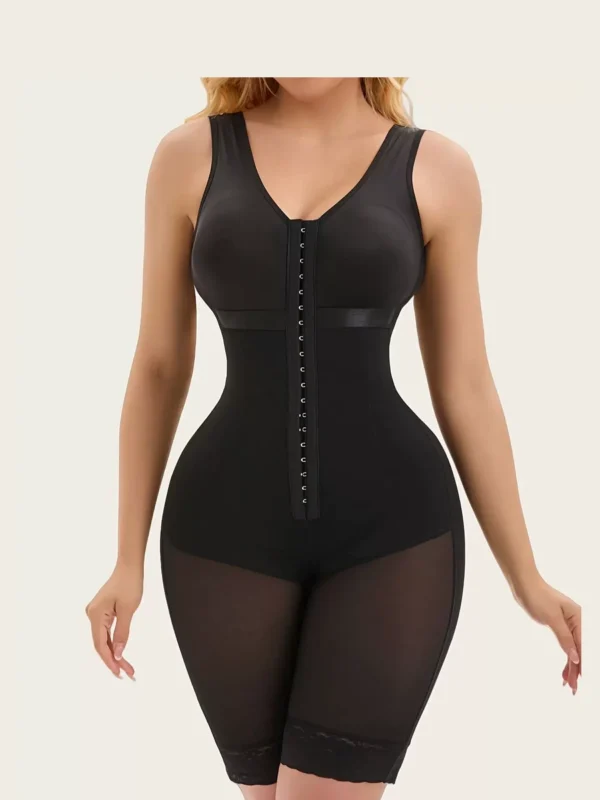
The Front-Hook Mid-Thigh Shaping Bodysuit lists open- or zipper-crotch variants. This demonstrates access choices, not postoperative approval.
Crotch-opening everyday example
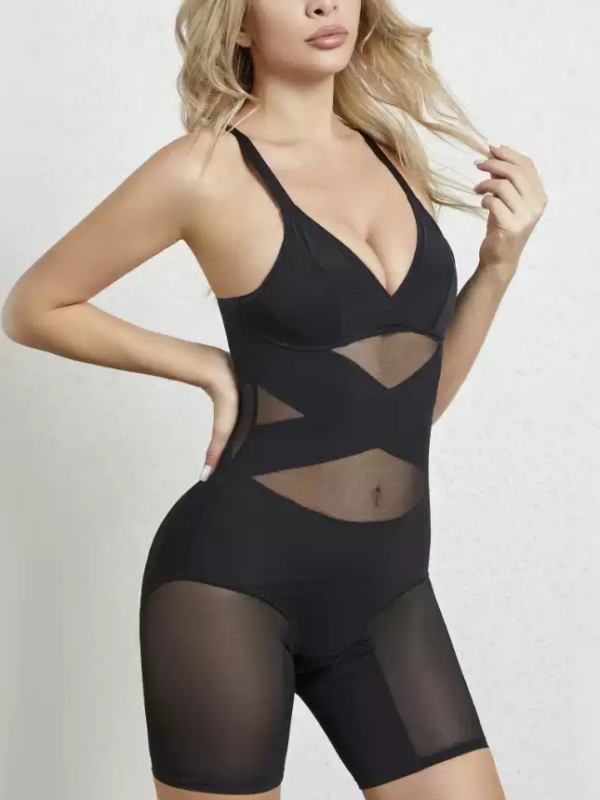
The Mesh-Panel Mid-Thigh Shaping Bodysuit names a crotch opening. Its everyday construction should not be treated as a recovery recommendation.
Post-lipo category example
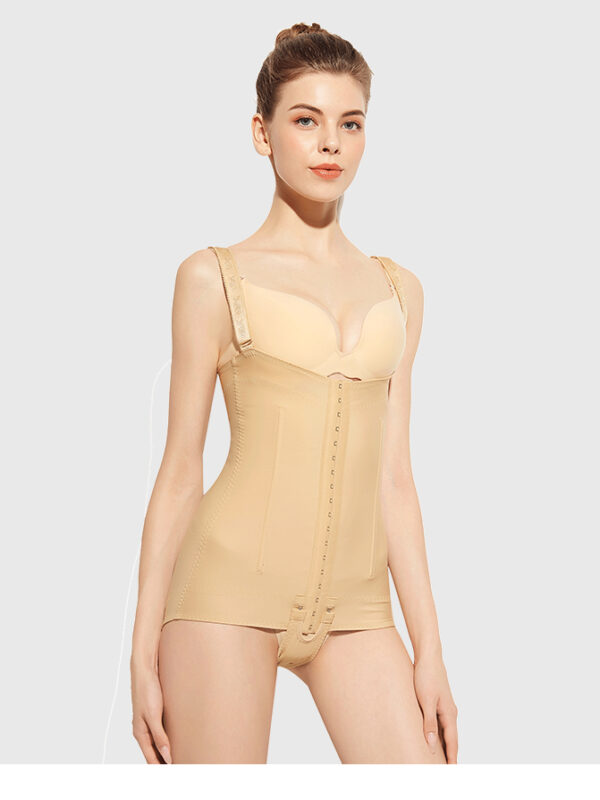
The Post-Lipo Open-Bust Compression Garment signals a recovery category, but its name does not establish open-crotch access or individual suitability.
Browse only after approval
Use the post-surgery shapewear collection as a catalog, not as a substitute for the clinician’s specification.
Compare access and category examples
These products were published and in stock in the August 28, 2026 Authority snapshot. Product 26243 and 8900 are access-construction examples; product 8336 is a post-lipo category example. None is recommended here for an individual recovery.
- Shapewear Bodysuits
Adjustable-Strap V-Neck Mesh-Panel Mid-Thigh Shaping Bodysuit – Crotch Opening
Original price was: $59.00.$39.00Current price is: $39.00.Select options This product has multiple variants. The options may be chosen on the product page - Shapewear Bodysuits
Front-Hook Mid-Thigh Shaping Bodysuit – Open or Zipper Crotch
Original price was: $69.00.$49.00Current price is: $49.00.Select options This product has multiple variants. The options may be chosen on the product page - Fajas & Recovery Bodysuits
Post-Lipo Open-Bust Full-Body Compression Garment with Hook Closure
$79.00Select options This product has multiple variants. The options may be chosen on the product page
Fit checks are necessary but not sufficient
After the treating team approves the category and exact design, use current measurements and the live product chart. Verify that seams, edges, hooks and zippers do not cross prohibited zones. Confirm that the garment can be put on without unsafe strain and that the access mechanism works without contaminating or disturbing a care site. Ask what fit changes are expected as swelling changes and who should reassess the garment.
A garment that causes increasing pain, numbness, color change, breathing difficulty, one-sided swelling, broken skin or wound concerns requires prompt removal or medical direction as appropriate. Do not solve a concerning postoperative symptom by changing only a retail size. The operating team has the necessary procedure and examination context.
No universal schedule, pressure or stage
Patients frequently search for a fixed number of hours, days or weeks. The cited ASPS recovery page instead tells patients to follow their surgeon’s instructions and ask how long the garment will be needed. The 2023 review shows why evidence cannot be compressed into one number across different operations and outcomes. This page therefore does not publish a universal schedule or “stage” progression.
Likewise, a smaller size is not a pressure prescription. Pressure distribution depends on material, pattern, construction, body geometry and fit, and cannot be inferred from size-down advice. Use the specification supplied by the clinician and ask how the exact product should be verified.
An illustrative access decision
Imagine a patient whose clinician has approved a specific mid-thigh garment category and mapped required abdominal and flank coverage. Restroom independence is difficult. An open or zipper crotch may be worth comparing, but only after confirming that the opening edge, closure and removal method do not conflict with treatment sites or instructions. If one design crosses a sensitive zone, convenience does not outweigh the map; another approved access method or assisted removal may be needed.
This is a decision scenario, not a patient case or treatment recommendation. It illustrates the correct evidence order: clinical requirement first, construction comparison second.
What this page supports—and what it cannot
Supported here
- Construction differences among open, hook and zipper access
- Questions that translate a care plan into garment details
- ASPS procedure context and evidence limitations
Not established here
- That open-crotch construction improves healing
- A universal pressure, size, stage or wear schedule
- Suitability of any linked product for an individual patient
Take this checklist to the operating team
- Which treated areas require coverage, and are any zones meant to avoid pressure?
- Where are incisions, drains and sensitive sites, and how must they remain accessible?
- Is an open, hook or zipper crotch acceptable for this specific plan?
- Which measurements and product specifications should be used?
- Who checks the first fit, and what symptoms require removal or urgent contact?
- What written schedule and follow-up plan applies as swelling and recovery change?
Sources and evidence notes
- American Society of Plastic Surgeons: 2024 Plastic Surgery Statistics Report — reported member-surgeon liposuction counts and dataset limits.
- ASPS: Liposuction Recovery — surgeon-directed instructions, garment use context and questions to ask.
- Ormseth et al., 2023: The Use of Postoperative Compression Garments in Plastic Surgery—Necessary or Not? — heterogeneous evidence, possible benefits and possible complications across procedures.
- UPMC HealthBeat: Does Compression Clothing Help Circulation? — distinction between ordinary and medical-grade compression.
Sources, procedure figures, product status and internal links checked August 28, 2026. Editorial method: procedure counts were labeled to their source population; access features were separated from medical outcomes; no pressure, schedule, stage or product suitability was inferred. No clinician review is claimed.