

Substantively reviewed and updated: August 28, 2026 · Evidence and links checked August 28, 2026
Direct answer
After fat grafting or a BBL, choose a garment from the surgeon’s zone map—not from a generic “Stage 1,” “Stage 2” or pressure label. Ask the care team to identify donor sites, grafted areas, incision or drain access and any pressure-free zones. Then compare the exact rear panel, seams, edges, closures and coverage. No online page can prescribe the right pressure or wearing schedule for an individual operation.
- Map first.
Donor and grafted areas can require different decisions. - Inspect construction.
A product name does not prove zone suitability. - Surgeon controls timing.
Stage language is not a universal clinical schedule.
Quick FAQ
What areas should a garment compress after fat grafting or BBL?
Only the operating clinician can approve the map. Ask the team to identify donor sites, grafted sites, incision or drain access and any pressure-free zones before choosing a garment.
Does a BBL garment need an open or reduced-pressure rear panel?
That depends on the procedure and the surgeon’s written instructions. A product name or cutout does not prove that pressure distribution is right for you.
How long should you wear a garment after fat grafting?
There is no single online schedule. ASPS says duration varies by operation and surgeon preference; your own care team sets the schedule and stage changes.
Should you size down for stronger compression?
No. Smaller is not a pressure prescription. It can move seams, edges and panels into unintended zones. Use current measurements and obtain approval for the exact design.
This page owns garment zones—not the recovery calendar
Qinelle already has a BBL week-by-week garment checkpoint guide and a Stage 2 faja decision guide. Repeating those timelines here would create overlapping pages. This article has one narrower job: help a shopper compare garment architecture after the surgical team has defined where pressure, openings and access should be.
The old version contained fixed mmHg values, stage weeks, all-day schedules and claims about graft survival without product-specific pressure tests or an individualized medical source. Those statements were removed. They cannot be carried forward merely because they appeared in an older article.
Demand is real, but procedure volume is not product proof
The American Society of Plastic Surgeons’ 2024 report records 29,466 buttock augmentations with fat grafting performed by ASPS member surgeons in 2024, compared with 29,383 in 2023. That is an increase of 83 procedures, or approximately 0.28%. It shows a stable continuing audience for clear patient questions; it does not show that a garment improves outcomes.
Buttock augmentation with fat grafting
ASPS member-surgeon counts · United States · 2023 and 2024
Source: ASPS 2024 Plastic Surgery Statistics Report, page 6. Calculation: (29,466 − 29,383) ÷ 29,383 × 100. Counts do not measure garment safety, pressure or effectiveness.
What the evidence supports—and where it stops
ASPS’s 2025 compression-garment article says wearing duration varies by operation and surgeon preference and explicitly notes that there are no firm guidelines for how long each garment will be worn. It describes common Stage 1 and Stage 2 practices, but those examples are not personal instructions.
ASPS buttock-enhancement recovery guidance also directs patients back to their surgeon for the duration of a support garment and other recovery decisions. A 2023 peer-reviewed review of postoperative compression garments reports that evidence varies by operation and outcome. This is why the article focuses on questions, construction and documentation rather than promising swelling reduction, faster healing, preserved graft volume or a contour result.
Build the zone map before comparing products
Four questions that define the garment
Complete with the operating team before purchase, replacement or stage change.
This is a decision workflow, not a body map or medical protocol. The care team must supply the actual zones and schedule.
Zone-by-zone decision table
| Zone or feature | Question for the care team | What to inspect on the garment |
|---|---|---|
| Abdomen, flanks or thighs | Which donor sites require coverage, and where should garment edges end? | Panel reach, leg length, waist height and seam position |
| Grafted buttock or hip area | Is full, reduced or no garment pressure permitted? | Rear opening, fabric panel, edge tension and seam path |
| Incisions, drains or dressings | What must remain visible or accessible? | Closure direction, opening, gusset and removable access |
| Changing swelling and measurements | What change triggers refitting or replacement? | Adjustment rows, zipper strain, wrinkles and panel migration |
| Sitting, sleeping and movement | What positions and activities are permitted? | Do not infer positioning safety from an opening or product name |
Rear-panel designs are not interchangeable
An open rear can visually expose the grafted area, but the edge surrounding the opening still applies tension somewhere. A reduced-pressure or flexible panel may cover the area without using the same material as the donor zones, but its actual pressure remains unknown without testing. A full panel provides continuous coverage, which may or may not match the surgeon’s plan. The correct choice is therefore a three-way match: written zone instruction, current measurements and the exact garment architecture.
| Design | Potential decision advantage | Question that remains |
|---|---|---|
| Open or cutout rear | Makes the absence of a central fabric panel visible | Where do surrounding edges and seams transfer tension? |
| Reduced-pressure rear panel | Maintains coverage with differentiated construction | Has the clinician approved the actual panel and fit? |
| Full rear panel | Continuous fabric coverage and simpler outline | Is pressure over the grafted area allowed at this stage? |
| Separate bra and leggings | Separates torso and lower-body fit variables | Do waist edges overlap, gap or conflict with treated zones? |
Closures, seams and access can change the decision
Front hook rows may provide adjustment points, but the rows can also create concentrated edges. A zipper can make dressing simpler for some users, but the backing, placement and strain must be checked. An open gusset can reduce full-garment removal for bathroom access, but it does not solve drain, dressing or hygiene requirements. Long legs increase thigh coverage; they also add leg openings and more seam length.
Use the procedure and coverage guide to compare garment formats. Check the current Qinelle size guide, but do not use a retail chart as a substitute for the care team’s fit and pressure requirements.
Questions to send before you buy
- Which exact areas are donor sites and grafted sites? Ask for a marked diagram or written description.
- Which zones may have full, reduced or no pressure? Avoid translating this into a guessed mmHg number.
- Are rear openings, panels or seams restricted? Share the exact product images and specifications.
- What access is required? Confirm incisions, drains, dressings and bathroom needs.
- What changes require a new fit? Define when measurements, swelling or symptoms should trigger contact.
- Who approves a stage change? A retailer label is not clearance.
Compare verified product architecture
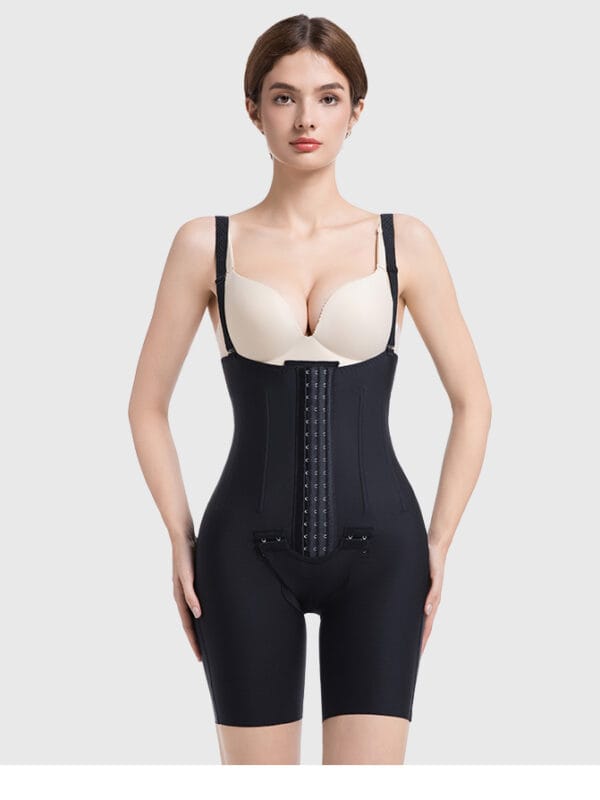
BBL recovery bodysuit
The QIN-8869 recovery bodysuit is an open-bust, front-hook format. Confirm its rear construction and coverage with the care team.
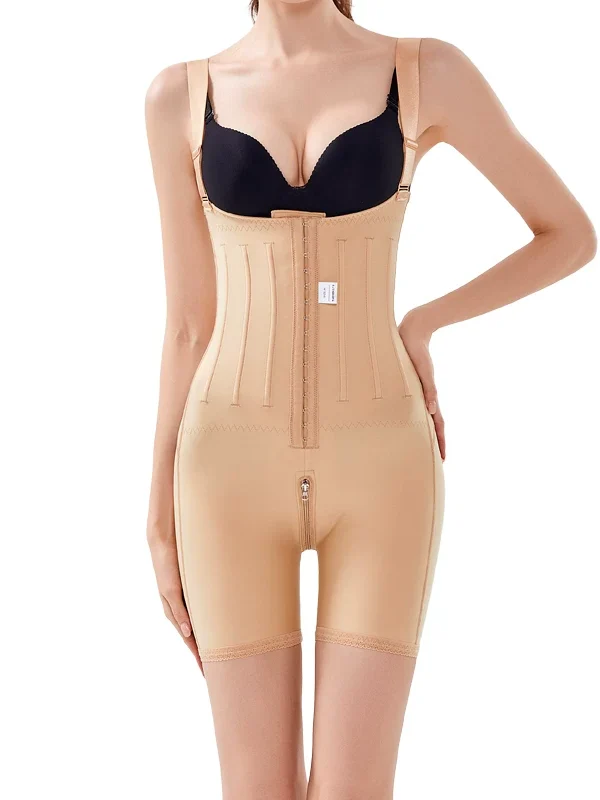
Bodysuit with buttock openings
The QIN-8668 bodysuit visibly includes buttock openings. The opening alone does not establish pressure suitability.
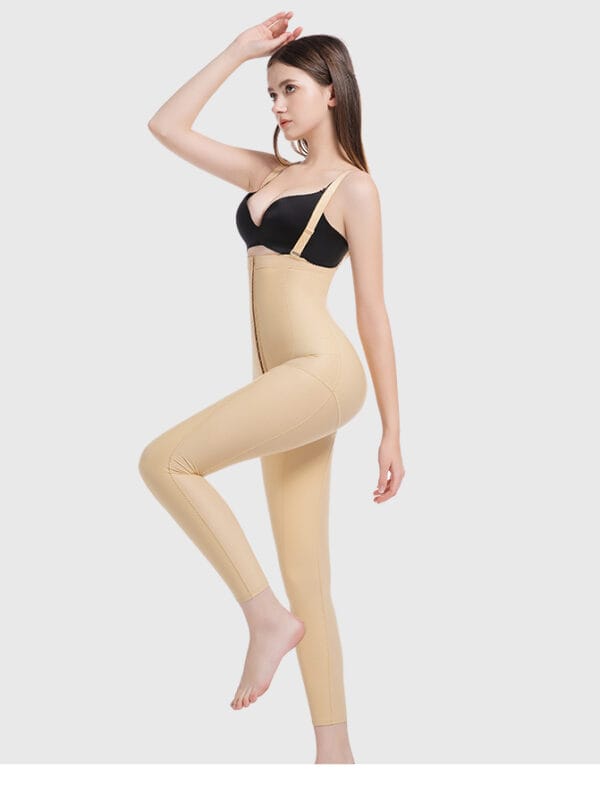
Separate bra and leggings set
The QIN-8756 set separates upper and lower coverage. Check waistband placement and every treated zone.
Compare stage terms
Read Stage 1 versus Stage 2 terminology before assuming labels create a medical standard.
Current garment examples for clinician review
These products were published and in stock in the August 28, 2026 Authority snapshot. Listing them does not approve them for an operation. Send the exact product page to the treating team before purchase or stage change.
- Recovery Sets
Post-Op Compression Bra & Leggings Set – BBL-Safe
$89.00Select options This product has multiple variants. The options may be chosen on the product page - Fajas & Recovery Bodysuits
Sleeveless Open-Bust BBL Recovery Compression Bodysuit with Front Hooks
$99.00 Select options This product has multiple variants. The options may be chosen on the product page - Fajas & Recovery Bodysuits
Sleeveless Open-Bust Post-Surgery Compression Bodysuit with Buttock Openings
$89.00Select options This product has multiple variants. The options may be chosen on the product page
Evidence boundaries
This guide can support
- A structured conversation about zones and access
- Comparison of visible garment construction
- Detection of unsupported product-pressure claims
This guide cannot establish
- Your required pressure, schedule or stage
- Graft survival, swelling reduction or complication prevention
- Clearance for sitting, sleeping, exercise or a garment change
Continue with the right BBL guide
For repeatable follow-up questions, use the BBL garment checkpoint guide. For a possible stage change, use the Stage 2 faja guide. For donor-area and liposuction garment questions, use the liposuction compression garment pillar. Each page owns a separate decision so the same broad recovery topic is not duplicated.
Sources and evidence notes
- ASPS: 2024 Plastic Surgery Statistics Report — 2023 and 2024 member-surgeon procedure counts.
- ASPS: Why Compression Garments Are Your Best Friends in Recovery — surgeon preference, stage examples and absence of firm universal duration guidelines.
- ASPS: Buttock Enhancement Recovery — surgeon-directed support garment and recovery context.
- Ormseth et al., 2023 — practical review of postoperative compression evidence and limitations.
Sources, calculations, product availability and internal links checked August 28, 2026. Editorial method: unsupported legacy pressure, wear-time, healing and graft-survival claims were removed; product features were limited to the live Authority record and visible product identity. No clinician review is claimed.