

Substantively reviewed and updated: August 28, 2026 · Evidence and links checked August 28, 2026
Direct answer
The history of shapewear is not one continuous invention and cannot responsibly be reduced to an unsupported “5,000-year” origin story. Surviving European corsets and museum records provide clear evidence for structured foundation garments by the eighteenth century. Industrial sewing and metal components expanded production in the nineteenth century; elasticized foundation garments reduced rigid boning in the early twentieth; spandex was developed in 1958; and later stretch fibers, engineered knits, bonded edges and modular designs enabled today’s briefs, shorts and bodysuits. Each stage changed the materials and fit problem—not the legitimacy of any body shape.
- Evidence has dates.
Museum objects anchor the timeline more reliably than an unattributed ancient-origin claim. - Change was not linear.
Corsets, bras, girdles and stretch garments overlapped across markets and decades. - Materials changed fit.
Rigid support, elastic panels and seamless knits create different structures and tradeoffs.
Quick FAQ
When did shapewear begin?
There is no single universally accepted start date. Museum collections document structured European corsets by the eighteenth century, while body-shaping garments in different cultures require their own evidence and terminology.
What replaced corsets?
No single garment replaced them at once. Bras, elasticized girdles, corselets and later stretch briefs, shorts and bodysuits overlapped as clothing, materials and social preferences changed.
When was spandex invented?
Chemist Joseph Shivers developed the stretch fiber later branded Lycra at DuPont in 1958, according to the Science History Institute. Commercial adoption followed rather than happening in one instant.
Are corsets and modern shapewear the same?
No. Both can influence the clothed silhouette, but their materials, construction, coverage, fit, fastening and intended use can differ substantially. Modern everyday shapewear should not inherit historical or medical claims by analogy.
A better way to read the history
“Shapewear” is a modern umbrella term. Earlier objects were described as stays, corsets, girdles, corselets, brassieres or foundation garments, and the boundaries between underwear, support and fashion changed over time. Treating every body-shaping practice as the same technology erases the differences that make the history useful.
This guide uses dated museum objects, curatorial essays and a science-history archive as anchors. A museum object proves that a particular construction survives from an attributed period; it does not prove that everyone wore it or that it was invented that year. A fiber-development date records a technical milestone; it does not mean every garment immediately adopted the material. Those limits are shown directly in the timeline.
Six documented transition points
Dates identify surviving objects or technical changes, not a single universal evolution
Sources: The Metropolitan Museum of Art, V&A and Science History Institute, checked August 28, 2026. “Today” describes current product construction, not a dated invention claim.
Before the nineteenth century: what surviving corsets can tell us
The Metropolitan Museum of Art’s corset dated to the first quarter of the eighteenth century provides a concrete material anchor. It shows that a structured European undergarment existed in this period, but it cannot serve as the origin of all body-shaping clothing. Survival is selective: garments are worn out, remade, discarded or collected according to institutional priorities.
The V&A’s Undressed: A Brief History of Underwear frames underwear history from the eighteenth century to the present, connecting intimate garments with fashion, health, morality and ideals of the body. That broader context prevents a technical history from becoming an endorsement of the social standards attached to a garment.
It also explains why “corset equals shapewear” is too simple. A structured corset can use boning, tightly fitted pattern pieces, lacing or a busk to establish form. A contemporary seamless brief relies on textile stretch and recovery. Both affect clothing silhouette, yet the way force is created and distributed can be very different.
The nineteenth century: industrial production changed the object
The V&A’s guide to Victorian underwear identifies several connected changes. Sewing machines entered corset production in the 1850s. Metal eyelets could strengthen lacing points. Split front busks made some corsets easier to put on and remove, while steam moulding in the 1860s helped manufacturers form curved shapes. These were manufacturing and access innovations as well as fashion changes.
Industrial scale did not create one standard experience. Materials, class, region, occupation, fashion and personal practice all affected what was available and how it was worn. Nor did an innovation instantly erase hand sewing or older forms. The evidence supports transition and coexistence, not a neat before-and-after switch.
Early twentieth century: elastic and changing silhouettes
A Met corset dated 1930–35 is described as using flexible elastic and less boning, evidence of a different mechanical strategy from many earlier structured examples. The V&A’s overview of body-shaping underwear also traces 1920s bandeau bras and later foundation garments as fashionable silhouettes changed.
No single product “replaced the corset.” Bras separated bust support; girdles addressed the lower torso; corselets connected areas; and corsets themselves continued in different forms. The important change was a growing design vocabulary. Garments could combine woven panels, elastic sections, hooks, zippers, straps and boning in different proportions.
| Construction family | Typical structure | Fit variables it emphasizes | What not to assume |
|---|---|---|---|
| Structured stays or corsets | Patterned woven sections, boning, lacing or busk | Torso shape, closure, vertical length and rigid edge placement | One surviving object represents all wearers or cultures |
| Elasticized girdles and corselets | Elastic panels combined with seams, fasteners and sometimes boning | Stretch recovery, waist/hip proportion and edge tension | Elasticity removed every fit or comfort problem |
| Cut-and-sew modern shapewear | Multiple stretch panels, linings, seams and closures | Panel placement, seam direction, openings and coverage | More panels automatically mean better results |
| Seamless knitted shapewear | Knitted tube or body with engineered zones and fewer sewn seams | Torso length, knit zones, openings and stretch compatibility | “Seamless” means literally no seams or universally invisible |
| Bonded or laser-cut edges | Thin cut edges and bonded joins in selected areas | Adhesive durability, edge placement, care and outer-fabric interaction | A raw-looking edge proves every component is bonded |
1958 and after: spandex changed the material toolkit
The Science History Institute records that DuPont chemist Joseph Shivers developed the stretch fiber later branded Lycra in 1958. Its archive also preserves a 1961 Lycra advertising proof, a useful distinction between technical development and commercial communication.
Spandex did not make earlier textile knowledge irrelevant. Modern garments usually combine fibers: one may contribute stretch and recovery, another surface feel, moisture behavior, strength or dye performance. Fiber percentages also do not fully explain a garment. Yarn, knit structure, panel orientation, stitch, elastics, bonding and finishing shape the result. For a contemporary construction explainer, see how shapewear is made.
The V&A’s body-shaping underwear history connects Lycra with changes in foundation garments during the 1960s. That is evidence of growing adoption, not a claim that all modern shapewear began in one decade.
From stretch fabric to engineered garment architecture
Current shapewear uses several construction routes. Cut-and-sew garments can place different fabrics or reinforcement panels at selected zones. Circular or seamless knitting can vary knit density within a tube-shaped component. Bonded edges can reduce bulk in some places, while sewn seams remain useful for shaping, strength or attaching closures. A garment marketed as seamless may still contain gusset, strap or finishing seams.
Architecture matters more to a shopper than a vague story of technological progress. A high-waist brief has an upper edge that must land compatibly with the torso and outfit. Shorts add thigh coverage and leg openings. A bodysuit connects the torso and lower body, so bust design, straps, gusset access and torso length enter the fit equation. Read one-piece shapewear versus separates and choose by body measurements and outfit.
A modern catalog is plural, not one “final form”
Published in-stock category snapshot on August 28, 2026; categories may overlap
Source: Qinelle Batch06 Authority snapshot, generated August 28, 2026, containing 247 product records. Counts describe current category architecture; they do not measure historical prevalence, demand or effectiveness.
Corset versus contemporary shapewear
| Question | Historical structured corset | Contemporary everyday shapewear |
|---|---|---|
| Primary structure | Often woven pattern pieces reinforced with boning and controlled by lacing or a busk | Often stretch blends, knitted zones, elastic edges, panels, seams or bonding |
| How fit is adjusted | Pattern, length, closure and lacing interact | Ready-to-wear size, stretch, torso/hip/bust proportion and openings interact |
| Common coverage | Varies by period and object; frequently centered on the torso | Brief, short, waist, bodysuit and other modular coverage options |
| Evidence needed | Object record, provenance, date range and curator context | Current chart, fiber and care disclosures, construction and product status |
| Claim boundary | One object cannot represent every wearer or social meaning | A control label cannot establish medical pressure or permanent change |
How this history changes a modern buying decision
- Name the architecture. Decide whether the outfit calls for a brief, short, waist garment, bodysuit or separate combination.
- Use current measurements. History explains materials; it does not replace the exact product chart or size guide.
- Inspect the construction. Look for panel, opening, strap, gusset, closure, seam and edge locations that interact with the outfit.
- Separate label from performance. “Seamless,” “firm” and “sculpting” need product-specific evidence and do not certify invisibility or medical pressure.
- Test movement and access. Stand, sit, walk, bend and use the restroom before a longer wear. The first-wear fit test defines stop signals.
The history is valuable when it makes today’s decision more precise. It should not suggest that modern garments are automatically safer, better or more liberating than every earlier form; those judgments require a defined product, wearer and context.
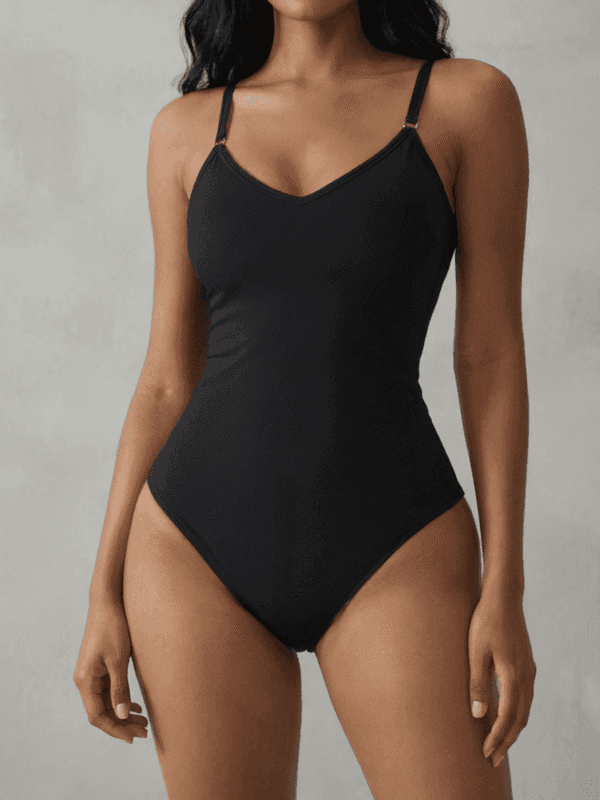
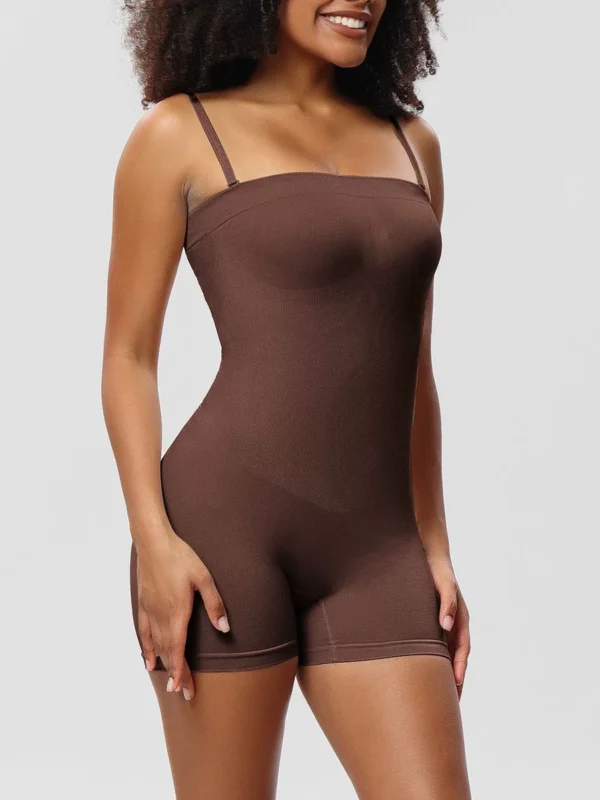
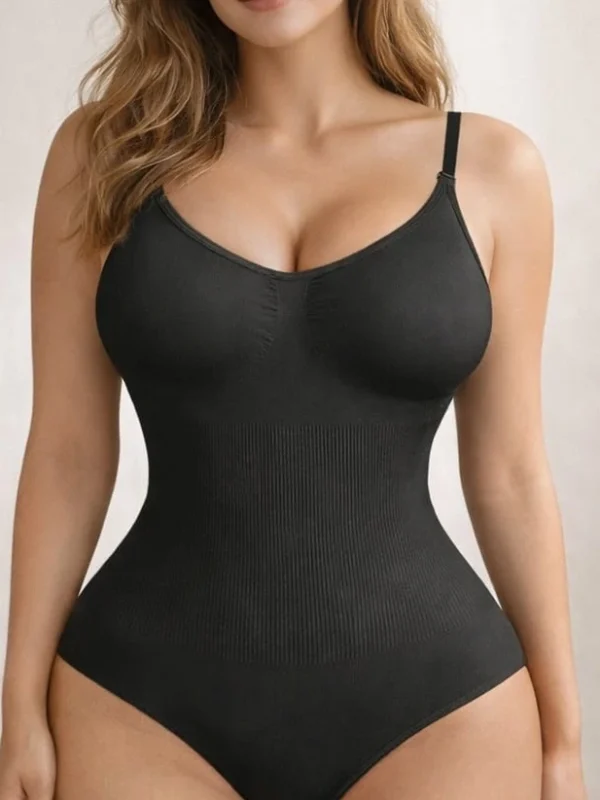
Three current bodysuit constructions
These published, in-stock products were verified in the August 28, 2026 Authority snapshot. They show how neckline, strap, brief/short and torso architecture vary within one modern category; they are not evidence of historical prevalence or medical effects.
- Shapewear Bodysuits
Seamless Adjustable-Strap Shaping Bodysuit – Brief or Thong
Original price was: $49.00.$29.00Current price is: $29.00.Select options This product has multiple variants. The options may be chosen on the product page - Shapewear Bodysuits
Seamless Convertible-Strap Shaping Bodysuit with Shorts
Original price was: $39.00.$29.00Current price is: $29.00.Select options This product has multiple variants. The options may be chosen on the product page - Shapewear Bodysuits
Seamless Tummy Control Bodysuit for Smooth Everyday Outfits
Original price was: $39.00.$29.00Current price is: $29.00.Select options This product has multiple variants. The options may be chosen on the product page
What the evidence can and cannot establish
Supported here
- Dated museum examples from the eighteenth and twentieth centuries
- Documented nineteenth-century production changes
- Joseph Shivers’s 1958 spandex milestone
- Current construction choices visible in a dated catalog snapshot
Not established here
- A universal first shapewear garment or one straight evolutionary line
- That a museum object represents all people in its period
- That newer technology guarantees comfort, fit or social progress
- Medical suitability, measured pressure or permanent body change
How to verify a historical claim yourself
Start with an object page or archive record that names the institution, date range, materials and accession information. Then use a curatorial overview to understand how the object relates to fashion and production. For a technical material claim, prefer a science-history archive, patent, company record or scholarly source that distinguishes invention, branding and market adoption. Be wary of timelines that jump from an ancient civilization to a modern product without objects, dates or citations.
Finally, separate historical evidence from current product advice. Use shapewear basics for present-day terminology, how to wear shapewear for dressing technique, and the safety guide for symptom boundaries. History can explain why a construction exists; it cannot decide an individual fit by itself.
Sources and evidence notes
- The Met: Corset, first quarter of the 18th century and Corset, 1930–35 — dated material anchors.
- V&A: Corsets, crinolines and bustles — industrial production, materials and nineteenth-century construction changes.
- V&A: Shaping the body — transitions in foundation garments and Lycra-era context.
- Science History Institute: A Synthetic History and its 1961 Lycra advertising proof — 1958 fiber development and later communication.
Sources, product status and internal links checked August 28, 2026. Editorial method: dates were tied to museum objects, curatorial records or science-history archives; invention, surviving-object date and commercial adoption were kept distinct; current catalog counts came from the dated 247-product Authority snapshot. No clinician review is claimed.