

Substantively reviewed and updated: August 28, 2026 · Evidence scope: garment construction and textile testing
Direct answer
Shapewear works as a garment when stretch fabric, pattern engineering, panels, seams and closures work together to redistribute fabric tension and smooth the outline while it is worn. Fiber percentages alone cannot prove support, comfort or durability. A credible comparison needs the exact product label, construction inspection and repeatable stretch-and-recovery and care testing—not a generic claim such as “high compression.”
- Fabric is one variable: knit structure, weight, direction of stretch and recovery matter alongside fiber content.
- Pattern controls placement: panels, seams, edges and torso length decide where tension is distributed.
- Claims require tests: without a named method, specimen count and result, a performance number is not evidence.
Quick FAQ
What fabric is best for shapewear?
There is no universally best blend. Compare the label, knit or woven structure, stretch direction, recovery, hand feel, opacity and care instructions for the intended garment.
Does more elastane mean stronger shapewear?
Not necessarily. Fiber percentage does not reveal fabric weight, knit density, panel layout, dimensions after repeated extension or pressure on the body.
What makes shapewear stay in place?
Correct size and torso length come first. Waistband design, leg openings, grippers, panel direction and seam placement can also affect rolling or migration.
How can quality be verified?
Use identified samples and a documented protocol for measurements, stretch, growth or recovery, seam and closure checks, wear trials and care cycles. Publish the method with any result.
How shapewear is made: the four-stage evidence chain
A finished body shaper is a system, not a single “magic” fabric. The useful question is whether the design inputs lead to a consistent, verifiable garment. This process map shows where a manufacturer can collect evidence before making a performance claim.
From specification to verified garment
Process diagram—not a claim that every Qinelle product has completed every test.
Reference framework: ISO 20932-1:2018 describes strip-test methods for fabric elasticity; ASTM D2594-20 covers stretch and growth of low-power knitted fabrics; FTC rules require truthful fiber and care information. Standards define methods, not a universal “good” result.
1. Fiber content tells you composition—not performance
In the United States, the FTC Textile Fiber Rule requires covered textiles to disclose generic fiber names and their percentages by weight, along with responsible-business and country-of-origin information. That makes the sewn-in label a useful factual starting point.
It is not a performance certificate. Two fabrics with the same nominal nylon–elastane blend can differ in yarn size, knit geometry, density, finishing, weight and usable stretch. Those differences can change opacity, surface feel, force during extension and how closely a fabric returns toward its original dimensions.
| Information | What it establishes | What it does not establish |
|---|---|---|
| Fiber percentages | Composition by weight under the applicable labeling rule | Compression level, recovery, lifespan or comfort |
| “Seamless” description | A low-seam or circular-knit construction category, if accurately used | No visible lines under every outfit or no irritation |
| “Firm” or “extra control” | A retailer’s relative product-positioning term | A standardized pressure value across brands |
| Product measurements | Dimensions of the stated size when the method is defined | How the item will fit every body shape |
| Test result | The result for the named samples under the stated method | Performance outside that sample, method or use condition |
2. Knit structure and stretch direction change the job
Stretch should be evaluated in the direction relevant to the pattern piece. A waistband may need different behavior from a rear panel or leg opening. Four-way stretch is a useful retail shorthand, but it should not replace measured lengthwise and widthwise results when a numerical performance claim is made.
ISO 20932-1:2018 describes straight-strip or loop methods for measuring elasticity and related fabric properties. ASTM D2594-20 covers fabric stretch under a known load and fabric growth after extension and release for low-power knitted fabrics. ASTM explicitly notes that other methods are more appropriate for some support or high-power applications. That limitation is important: a method must match the material and claim.
3. Pattern engineering determines where tension goes
Patterns convert flat fabric into three-dimensional coverage. A high waist that is too short for the wearer may roll even when the fabric is excellent. A mid-thigh style can smooth the thigh-to-garment transition but introduces a leg opening that must stay in position. A bodysuit can remove a separate waistband, yet adds torso-length, bust, gusset and strap variables.
| Construction element | Designed role | Check on the body | Common failure signal |
|---|---|---|---|
| Single-layer stretch panel | Flexible coverage with fewer transitions | Does it lie flat through movement? | Sheerness, drifting or uneven tension |
| Reinforced or double panel | More structure in a defined zone | Does the boundary sit in the intended place? | A visible ridge or concentrated pressure |
| High waistband | Extends coverage above the natural waist | Is rise compatible with torso length? | Rolling, folding or rib contact |
| Mid-thigh leg | Continues smoothing through the upper thigh | Does the hem stay flat during sitting and walking? | Curling, digging or a sharp line |
| Open-bust bodysuit | Connects torso and lower-body coverage while using a separate bra | Are armholes, straps and torso length aligned? | Pulling at shoulders, bust edge or gusset |
4. Seams, closures and edges can decide comfort
Seams join materials but can also create ridges. Hooks and zippers add adjustability or access but require stable alignment, protective facing and a compatible torso length. Bonded edges may reduce bulk; elastic or silicone grippers may resist migration. None is automatically superior. The right construction depends on skin contact, movement, outfit and care.
Seam inspection
Look for skipped stitches, loose ends, puckering, sharp thread ends and abrupt panel transitions. Inspect the seam while relaxed and gently extended.
Closure inspection
Open and close every position. Check hook attachment, zipper tracking, protective backing and whether the closure stays flat during permitted movement.
Edge inspection
Examine waistband, armhole, gusset and leg finish for twisting, exposed elastic or a local pressure point.
Placement inspection
Confirm that reinforced panels and seams sit where the product design intends after the garment is fully pulled into place.
A transparent stretch-and-recovery test plan
Qinelle has not supplied laboratory result files for publication in this article, so no brand-specific stretch percentage or recovery claim is reported here. The following is a disclosure checklist for future testing, not a substitute for the full ISO or ASTM standard.
| Record field | Why it matters | Publish with the result |
|---|---|---|
| Product, lot and sample selection | Prevents an unrepresentative specimen from standing in for an entire line | SKU, color/lot where relevant, number of garments and specimens |
| Conditioning and direction | Temperature, humidity and fabric direction can affect comparison | Conditioning protocol; lengthwise/widthwise or pattern-piece orientation |
| Method and apparatus | Results depend on how load or extension is applied | Standard/version or complete internal method; equipment and settings |
| Timing and repetitions | Immediate stretch and post-release growth answer different questions | Hold/recovery intervals, cycle count and specimens per condition |
| Raw and summary results | A single average can hide variation | Individual results, mean or median as appropriate, range and units |
| Limitations | A fabric strip is not the same as a finished garment on every body | Material, size, method and real-use boundaries |
Care testing is part of construction quality
Heat, agitation and drying can change elastic textiles, but the correct instruction must come from the exact garment label. The FTC Care Labeling Rule requires covered manufacturers and importers to provide regular care instructions and possess a reasonable basis for them. It does not justify applying one generic wash rule to every shapewear product.
For a verified care claim, record garment dimensions and construction observations before and after the specified care cycles. Note seam, closure, edge, appearance and fit changes. Consumers should follow the sewn-in label; our shapewear care and replacement guide explains condition-based checks without inventing a universal lifespan.
How to compare shapewear before buying
- Define the outfit and area. Decide whether you need waist, thigh, torso, back or low-back coverage. Start with the shapewear selection guide.
- Read the exact label and product chart. Use current body measurements. Do not infer performance from blend percentages or order smaller for “more compression.”
- Map construction boundaries. Locate waist, leg, bust, armhole, gusset, seam, panel and closure positions relative to your outfit and body.
- Run a functional fit check. Breathe normally, sit, stand and walk. Stop if there is pain, numbness, breathing restriction or persistent skin irritation.
- Keep only evidence-based expectations. Expect a temporary clothing-silhouette change while worn—not permanent body reshaping or a medical outcome.
Three construction formats to inspect
| Product | Construction cue | Fit variables to verify |
|---|---|---|
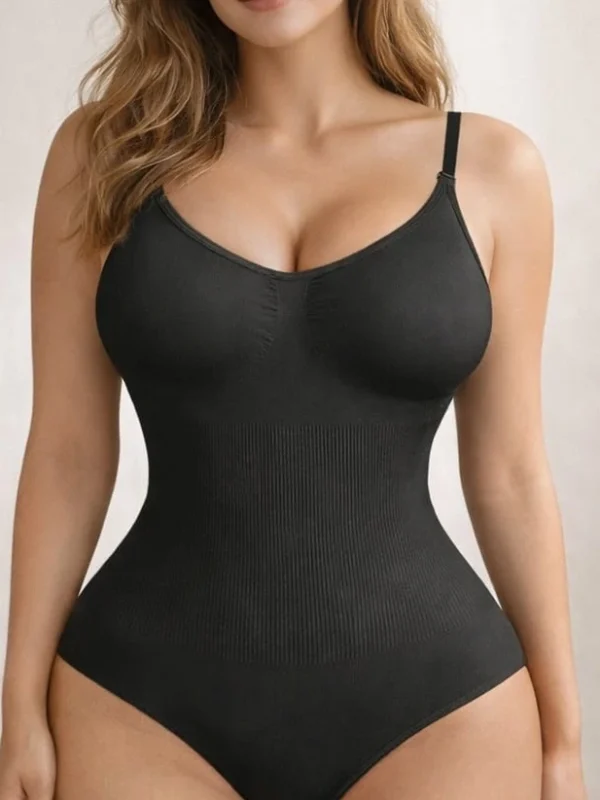
| Seamless Tummy Control Bodysuit for Smooth Everyday Outfits | Seamless bodysuit format | Torso length, neckline, armholes, leg opening and gusset |
| Open-Bust Front-Hook Mid-Thigh Shaping Bodysuit with Lace Trim | Front closure, open bust and mid-thigh coverage | Hook alignment, torso length, bra compatibility and leg hem |
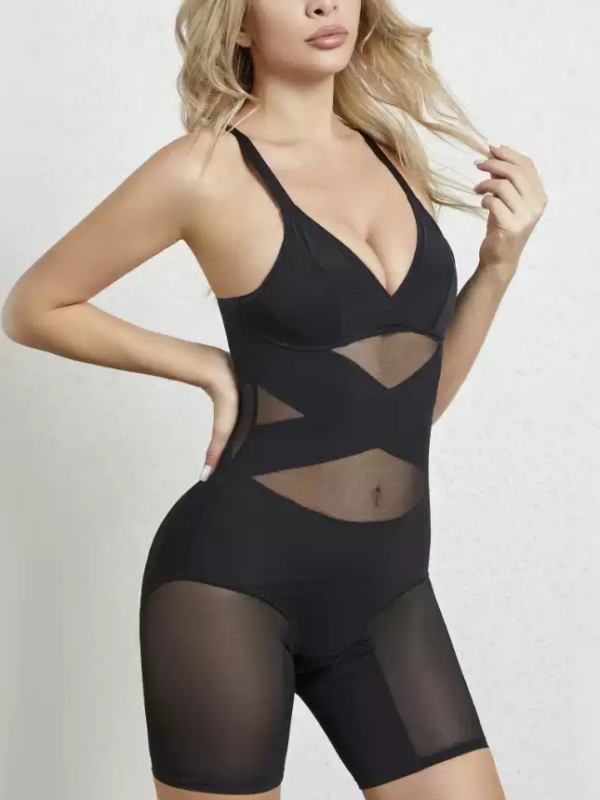
| Adjustable-Strap V-Neck Mesh-Panel Mid-Thigh Shaping Bodysuit | Mesh panels and adjustable straps | Panel transitions, strap range, crotch access and thigh edge |
Compare the three formats
Product names describe catalog features; they do not certify a pressure value, medical indication or quantified durability result. Recheck the live product page, size chart and care label before purchase.
- Shapewear Bodysuits
Adjustable-Strap V-Neck Mesh-Panel Mid-Thigh Shaping Bodysuit – Crotch Opening
Original price was: $59.00.$39.00Current price is: $39.00.Select options This product has multiple variants. The options may be chosen on the product page - Shapewear Bodysuits
Open-Bust Front-Hook Mid-Thigh Shaping Bodysuit with Lace Trim
Original price was: $59.00.$39.00Current price is: $39.00.Select options This product has multiple variants. The options may be chosen on the product page - Shapewear Bodysuits
Seamless Tummy Control Bodysuit for Smooth Everyday Outfits
Original price was: $39.00.$29.00Current price is: $29.00.Select options This product has multiple variants. The options may be chosen on the product page

For category context, continue with types and functions of shapewear and what shapewear can and cannot do.
Sources and standards
- ISO 20932-1:2018: Textiles—Determination of the elasticity of fabrics—Part 1: Strip tests — published 2018; confirmed 2024.
- ASTM D2594-20: Stretch Properties of Knitted Fabrics Having Low Power — method scope and limitations.
- U.S. Federal Trade Commission: Textile Fiber Rule, 16 CFR Part 303 — fiber-content and origin disclosures.
- U.S. Federal Trade Commission: Care Labeling Rule, 16 CFR Part 423 — care instructions and substantiation.
Sources, product availability and internal links checked August 28, 2026. ISO and ASTM standards are summarized at a high level; consult the licensed standard for the complete method.